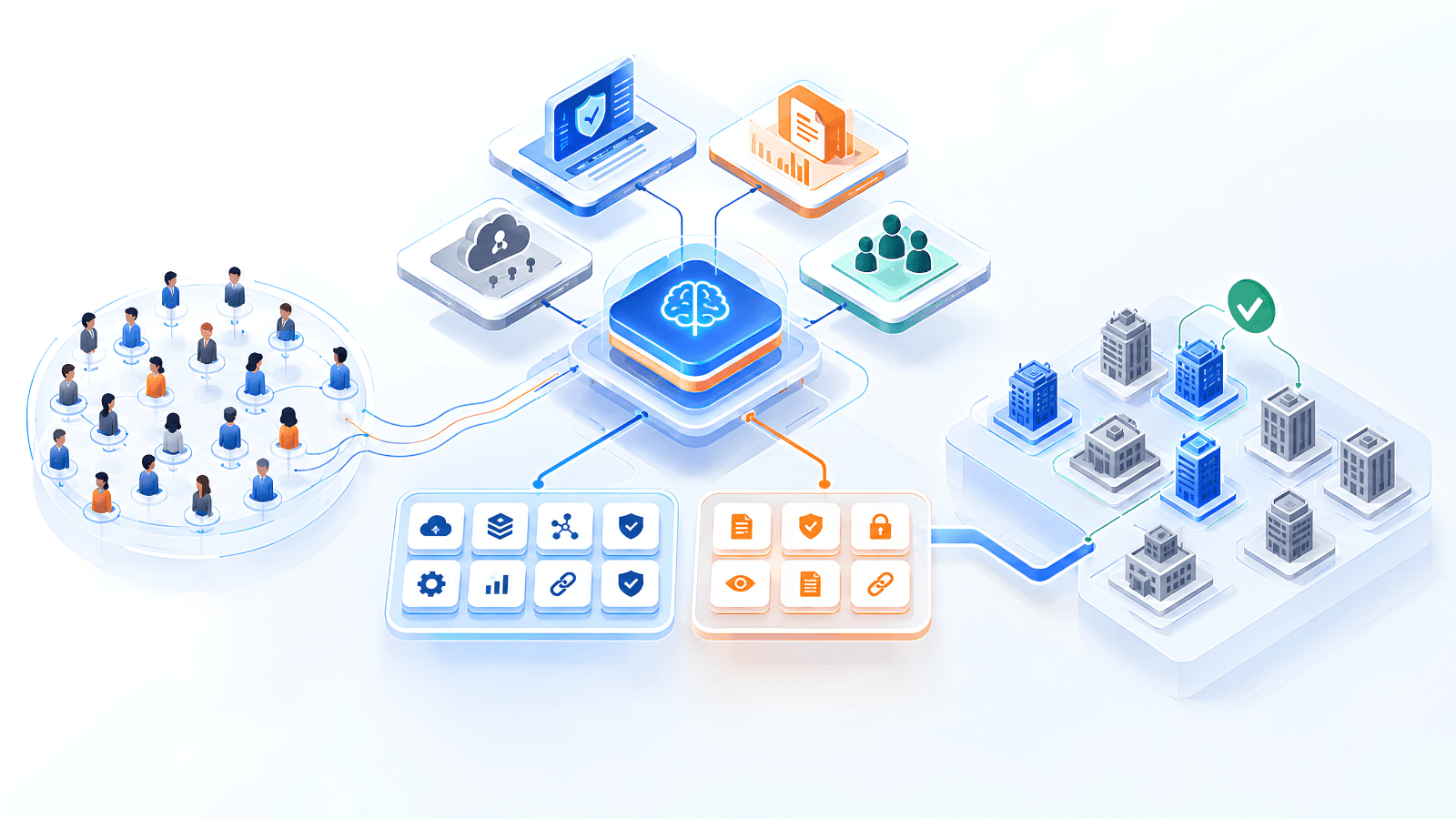
An origin-based definition of AI-native GRC, applied to everyone. Four platforms scored on eight architecture criteria and six disclosure facts, plus the nine vendors in the wider market that pass the origin test.
A brief by Supplier Shield. Four platforms scored in full on origin, architecture and disclosure, plus the wider AI-native field. Data collected September 2026. Where a vendor publishes nothing, the entry reads "not published."
TL;DR
"AI-native" now appears on GRC homepages whose products are decades old, so we use a strict, origin-based definition: a product is AI-native only if it had no pre-AI version. We then score four platforms on eight architecture criteria and six disclosure facts, and apply the same origin test to every other vendor we could find that claims or shows an AI-first origin.
Among the four, the definition leaves two groups. Acuna GRC is AI-native, while Swiss GRC, Vanta and Drata are AI-enabled, meaning established products with AI added. Acuna GRC is also the only one of the four where the customer chooses the model and processing region, through bring-your-own-key. The other three name neither their model provider nor where inference runs.
Across the wider market, nine vendors pass the origin test, six of them cleanly, and only two of those aim at the whole risk and compliance programme rather than certification work.
The short answer
Which answer applies depends on the decision you are making.
- You want a platform designed around AI from day one, governed by your people. Acuna GRC is the only one of the four that meets the origin test, and it documents all eight architecture criteria, including customer control of the model through bring-your-own-key.
- You need the most AI documentation from an established vendor. Drata publishes the most among the three incumbents: a no-training statement, an opt-out, a subprocessor pointer and an ISO 42001 certificate. It is AI-enabled, not native.
- You want a long-established Swiss vendor with an assistant on top. Swiss GRC fits, as long as you buy it as AI-enabled despite the label. Its assistant cites the records it used and respects user permissions.
- You are buying governance of your own AI systems. Then you are in a different market (AI governance platforms), and this brief covers the wrong product.
By the numbers
- 1 of 4 platforms lets the customer choose the model and processing region, through bring-your-own-key.
- 0 of the other 3 name the model provider behind their assistant or state where AI inference runs.
- 4 of 4 publish a written no-training commitment, though the wording varies (see the disclosure index).
- 2 of 4 document an off switch for the AI.
- 1 of 4 passes the origin test for AI-native.
- 1 of 4 calls itself AI-native while presenting its product as the result of more than 30 years of experience.
- 9 vendors in the wider market pass the origin test, 6 of them cleanly, and 2 of those aim at the whole GRC programme.
- 3 years is how long Swiss-region inference has been available from at least one major provider: Microsoft announced Azure OpenAI Service in the Switzerland North cloud region on 18 September 2023.
Three products share one name
Search for "AI GRC" and you get three different markets on one results page.
A single vendor can sell all three. This brief covers the third row only, and it answers one question: when the assistant in your GRC tool reads your data, was it built for that job, and where does the data go?
AI-native, AI-transformed, AI-enabled: one definition, applied to everyone
None of these is a verdict on quality, since a mature product with a well-governed assistant can be the right purchase. The problem is a product that is AI-enabled but sold as AI-native, and the difference surfaces later in three places: what the AI can act on, what it can explain, and whether it works in the deployment you actually run.
The lineage test: four dates that settle most of it
- When was the company founded?
- When was the current product first released?
- When did the first AI feature reach paying customers?
- When did the vendor start calling the product AI-native?
Eight criteria an AI-native platform has to meet
Origin is only the entry condition, because a product born with AI that meets none of these criteria is native in name only.
- One data model the AI works on directly. Risks, controls, measures, evidence and suppliers are structured objects, not documents to summarise.
- Answers traceable to records. Every output names the objects it used.
- Proposals that cannot corrupt structure. The AI suggests; it cannot change identifiers, configuration or approval states on its own.
- Capabilities governed per role. The AI's permissions follow the same access profiles as the humans using it.
- A real off switch. Disabled means no call to any model provider.
- Data flows documented per feature. For each function, the vendor states what leaves the platform.
- Metered, capped consumption. AI usage is measurable and limitable.
- Named model, stated region, contractual no-training. All three are in writing, whether the vendor chooses them or the customer does.
Architecture scorecard
Acuna GRC documents all eight criteria; Swiss GRC documents four and a half, and Vanta and Drata one or less. Scores are based only on the vendors' public pages, and "not published" means we could not find it, not that the capability is absent.
Swiss GRC scores well on architecture despite failing the origin test, because its assistant is a careful piece of work. The label on top of it is the problem.
The disclosure index: can a DPO approve the assistant from what is published?
Acuna GRC leads at 4.5 of 6 because the customer can choose the model and region; Drata leads the incumbents at 3.5.
Two readings matter more than the totals.
Silence on model and region is a choice. Swiss-region inference has been available since 2023, so a vendor running its assistant in Switzerland could say so in one sentence. Bring-your-own-key answers the question differently: the customer picks the provider and region, and signs the terms directly.
No-training is now table stakes, but the wording varies. Vanta's commitment covers itself and any third party, Swiss GRC's covers content from your tenant, and Drata's is in the present tense: it does not currently train or fine-tune models on customer data. Ask for the commitment in the contract, not the help centre.
On our own score: Acuna GRC leads on both architecture and disclosure. The remaining gap is the subprocessor listing and the processing region for the model provided by Acuna GRC, so put those two questions to us exactly as you would to anyone else.
Who passes the origin test: the AI-native field in 2026
Nine vendors pass the origin test: six cleanly and three on conditions we state. Passing is only the entry condition, so the scorecard that follows shows how much of each architecture is documented.
Only Acuna GRC and Complyance aim at the whole risk and compliance programme; the others automate certification work or add an agent layer on top of it. None of the other eight is built around EU or Swiss regulation.
Architecture scorecard, wider field
Scoring: Yes = 1, Partial = 0.5. "Not published" means we could not find it.
Three readings stand out. Zania and Mycroft trade proposal-only behaviour for autonomy on purpose, which can suit some teams, and the buyer should choose it knowingly. HelmGuard has the most thorough traceability design among the newcomers, since each finding preserves the evidence examined, the reasoning, a confidence score and any human decision. Zania publishes the most on its own model hosting, while Acuna GRC is the only vendor that hands the model choice to the customer.
On Delve, the facts and the allegations stay separate. An anonymous whistleblower alleged fabricated audit documentation and pre-filled evidence, Delve strongly denied it, and no regulator has concluded that Delve committed fraud. We mark criteria 2 and 3 as contested for that reason and draw no further conclusion.
Claim AI-native, fail the origin test
Swiss GRC is the clearest case and is profiled below. TrustCloud was founded in 2019 and shipped compliance automation before generative AI, so its 2026 "AI-native Security Assurance Platform" is at most AI-transformed. Anecdotes is described in a reseller listing as the only AI-native enterprise GRC platform, but the company was founded in 2020, before large language models became usable, which puts it in the AI-enabled group.
Vendor profiles
1. Acuna GRC: AI-native, built for human governance
Origin. Acuna GRC was conceived by Alexis Hirschhorn, a recognised GRC expert who spent 30 years as CISO, DPO and Head of Compliance across banking, insurance, healthcare and high-growth technology. He is also a trainer with Abilene Academy, where he trains GRC and AI governance professionals; the Academy's published client list includes Deloitte, EY, KPMG, PwC, Nestlé, IBM and G42. He could not find a platform that did the operator's job well, so he built the one he wished he had, with a team that brings more than 100 years of combined experience in compliance, data protection and cybersecurity. That experience belongs to the people who designed the platform; the product itself was born in 2026, with AI in it from the first release. The platform was architected from the start around two goals: AI working directly on the programme's own data, and people holding every decision that matters.
What the AI does. Aiko is the platform's AI agent, reachable from every page and working across one shared data model of requirements, measures, controls, risks, evidence, suppliers and privacy records. It answers questions about your programme in plain language, citing the records it used and showing its reasoning; proposes cross-framework mappings with a confidence score and the reason for each match; evaluates supplier assessment responses question by question for an evaluator to confirm; answers ownership questions; and creates tasks and KPIs on request.
Human governance, built in:
- Aiko proposes and people decide on mappings and evaluations, and nothing is linked or scored until a person applies it.
- It acts only within the permissions of the person using it, following the same access profiles, with a separate permission for AI evaluation.
- The customer chooses the model: bring your own provider key, so model, region and terms follow your own contract, or use a model provided by Acuna GRC.
- An organisation-wide switch turns AI off, and off means no call to any AI provider.
- Usage is token-metered against a monthly budget, and data flows are documented feature by feature, with subject request and breach questions answered from metadata only.
Gap. The AI subprocessor listing and the processing region for the model provided by Acuna GRC are not yet published.
Fit. Organisations that want AI designed into the data model and governed by their own people, with EU and Swiss regulation at the core and control over which model processes their data.
2. Swiss GRC: AI-enabled, labelled AI-native
Origin. The GRC Toolbox is presented as the result of more than 30 years of experience, a lineage that runs through a sister company, while Swiss GRC AG was registered in 2016. The AI assistant followed in 2024.
What the AI does. Grace AI answers questions across risks, controls, policies and incidents, cites its sources and respects user permissions.
Strengths. Traceability, proposal-only behaviour and permission-aware answers.
Gap. No model or region published, no documented off switch, and an AI-native label contradicted by the product's own history.
Fit. Organisations that value a long-established Swiss vendor and want an assistant on a mature product. A side-by-side view is in the Acuna GRC and Swiss GRC comparison.
3. Vanta: AI-enabled, and describes itself accurately
Origin. Founded in 2018 to automate SOC 2. AI features from 2023, the AI Agent from July 2025.
What the AI does. Evidence collection, policy management and questionnaire drafting. Vanta also offers an MCP server and API for external agents.
Strength. A clear no-training commitment that extends to third parties, and a DPA with each model provider.
Gap. Providers not named, region not stated, off switch not found in public documentation.
Fit. Fast-moving companies automating SOC 2 and ISO 27001 at volume.
4. Drata: AI-enabled, the most disclosure among the incumbents
Origin. Founded in 2020. Describes itself as an agentic trust management platform.
What the AI does. Summarises vendor security documents, extracts compliance insights and drafts questionnaire responses.
Strengths. ISO 42001 certified, opt-out in settings, subprocessor list linked from the AI documentation.
Gap. Model and region unstated, and "does not currently" is a commitment with a tense.
Fit. Buyers whose committee wants the most published AI documentation from an established vendor. A side-by-side view is in the Acuna GRC and Drata comparison.
Six claims that do not survive the test
These are patterns. Where a vendor's public wording illustrates one, we state what the record shows.
1. "AI-native" on a product that predates its AI
Swiss GRC calls its offering an AI-native platform, while presenting its GRC Toolbox as the result of more than 30 years of experience, and its first AI assistant page dates from August 2024. A product that existed for years before its first AI feature is not AI-native under any origin-based definition. At most it could be AI-transformed, which would require a documented core rebuild, and we found none. The vendor's product experience and customer base are real strengths, just not the one its label claims. The distinction matters for every vendor, ourselves included: years of experience held by a team are a credential, while years attached to a product are its lineage.
2. "Works on your data, with no export"
From the user's seat this is true, since nothing is downloaded and no second tool is opened. It is not the same as "no data leaves the platform." An assistant answers by handing context to a language model, and unless that model runs inside infrastructure you have approved, your records travel to a model provider with every question. That provider is a fourth party in your supply chain. The claim describes the user experience, while the DPO's question is about data transfer.
3. "Agentic" meaning a chat panel
"Agent" now covers everything from a sidebar that drafts text to software that changes records on its own. When a vendor describes its assistant as a round-the-clock GRC engineer, treat that as a capability claim and test it with three questions:
- What can it change without approval?
- Under whose permissions?
- Where is each action logged?
4. "We don't train on your data," as the whole privacy answer
A no-training commitment addresses one risk and leaves four open: the inference call itself, where it runs, how long prompts are retained, and who can compel access. All four platforms here make the commitment, and only one lets the customer decide the model and region.
5. "Swiss-hosted" stretched to cover the AI
Where the database is hosted says nothing about where the assistant's inference runs, and the two can sit on different continents. Ask for the inference region separately, and ask where any vector index built from your documents is stored. Hosting, residency and key custody for the platform itself are covered in our Swiss GRC software brief.
6. "ISO 42001 certified," read as "safe to switch on"
ISO/IEC 42001 certifies an AI management system. It does not name your model, your region or your subprocessor, so read the certificate's scope and then ask the operational questions anyway.
Twenty questions to ask any vendor claiming AI-native
Questions 1 to 5 tell you what the product is, questions 6 to 10 whether "native" means anything in daily use, and questions 11 to 20 whether you can approve it at all. The wider pre-contract question set sits in our vendor due diligence checklist.
Origin
1. When was the company founded, and when was the current product first released?
2. When did the first AI feature reach paying customers?
3. Was the data model designed for AI, or does the AI read an existing schema?
4. Do you still sell or support a pre-AI version, and does the AI work there?
5. If you deploy on-premise, does the assistant run on-premise too?
Architecture
6. Does the AI work on structured objects or on documents and text fields?
7. Can every AI answer name the records it used? Show us one.
8. Can the AI write, or only propose? Under which permissions, and where is it logged?
9. Which core workflows have an AI path today, not on the roadmap?
10. Can external agents reach the same data, and under what controls?
Operations
11. Which model provider and version runs each feature, and can we bring our own?
12. Where does inference run, and do prompts, outputs, logs or vector indexes leave that country?
13. What notice do we get before you change model provider?
14. How do you test output quality before a model change reaches us?
15. Is AI usage metered, and can we cap it?
16. Does "off" mean no call to any provider?
Contract
17. Is AI included in the platform price or sold as an add-on? Our GRC pricing benchmark shows where add-ons usually sit.
18. Is the no-training commitment in the contract, and does it bind the model provider?
19. Is the model provider on the subprocessor list we sign?
20. Who is accountable when an AI-drafted mapping is wrong and ends up in an audit file?
Red flags and green flags
The legal frame, briefly
Switzerland. There is no AI act, and none is needed to reach your GRC assistant. The FDPIC's position is that the Federal Act on Data Protection, in force since 1 September 2023, applies directly to AI-supported data processing, and that manufacturers, providers and users must make the purpose, functionality and data sources of AI processing transparent. If the assistant processes personal data, and GRC data is full of it, the model provider is processing on your behalf and belongs in your records and contracts. Switzerland signed the Council of Europe AI Convention in March 2025, and the Federal Council has announced the legal amendments needed to ratify it.
The EU. Regulation (EU) 2026/1744, the Digital Omnibus on AI, entered into force on 27 July 2026. Stand-alone Annex III high-risk obligations now start on 2 December 2027, and Annex I product-embedded obligations on 2 August 2028, so any page still citing 2 August 2026 for high-risk obligations is out of date. A compliance assistant is not an Annex III use case; what reaches it is Article 50 transparency, which applies from 2 August 2026, and AI literacy measures.
Supervised entities. For a FINMA-supervised institution, the assistant's model provider belongs in the same outsourcing and secrecy analysis as the GRC vendor itself. Bring-your-own-key simplifies that analysis, because the institution can run the assistant on a provider already approved in its outsourcing register.
Which platform to shortlist if
FAQ
What does AI-native GRC mean?
The product was conceived and first released with AI in its data model and workflows, and no pre-AI version exists. Origin is the test, and it cannot be added later. On top of origin, look for AI that works on structured records, cites its sources, proposes rather than overwrites, and can be switched off completely.
Can a GRC vendor with a long history be AI-native?
Not with the product it already had. An established vendor can become AI-transformed by rebuilding its core, and the migration and release notes will show it. A new product launched by an established company can be AI-native, while an old product with a new assistant is AI-enabled, whatever the homepage says.
Is Swiss GRC AI-native?
Not under an origin-based definition. Swiss GRC presents its product as built on more than 30 years of experience, its first AI assistant appeared in 2024, and we found no documented core rebuild. On the public record it is AI-enabled, with a well-designed assistant. For a direct comparison, see Acuna GRC vs Swiss GRC.
Is Vanta AI-native?
Vanta does not claim to be in the sources we reviewed. It began in 2018 automating SOC 2 and describes itself as AI-powered and agentic, which is accurate for an AI-enabled product.
Which GRC platforms are AI-native?
Nine vendors pass the origin test in our review: Acuna GRC, Complyance, Zania, HelmGuard, Comp AI and Mycroft cleanly, and Vendict, Delve and 1CISO on stated conditions. Of these, Acuna GRC and Complyance aim at the whole risk and compliance programme.
What is the difference between AI governance software and a GRC platform?
AI governance software governs your own AI systems, while a GRC platform runs your risk and compliance programme and may use AI to do it. Decide which problem you are solving before you shortlist.
Does my GRC vendor train AI models on my data?
All four vendors scored in full publish a no-training commitment. Get it in the contract and check that it binds the model provider.
Can GRC AI processing stay in Switzerland?
Technically yes, since Swiss-region inference has existed since 2023. With Acuna GRC's bring-your-own-key, the customer can connect a provider running in a Swiss region; none of the other three vendors publicly states where its assistant runs, so ask them in writing.
Is the model provider a subprocessor under the FADP and GDPR?
In most configurations, yes. If personal data reaches a model provider processing on the vendor's behalf, that provider should be on the subprocessor list you sign. With bring-your-own-key, the provider contracts with you directly. Our fourth-party map shows how often these providers converge on the same few companies.
Can I turn off the AI in my GRC platform?
Acuna GRC and Drata document an off switch. Ask any vendor whether "off" means no call to any provider.
Does the EU AI Act apply to the AI in my GRC tool?
Mostly through transparency and AI literacy, not the high-risk regime. The high-risk dates moved to December 2027 and August 2028 under Regulation (EU) 2026/1744.
Is bolted-on AI worse than native AI?
Not automatically, because a mature product with a well-governed assistant can outperform a thin native one. The risk is buying one while being sold the other.
Limits of this brief
- Coverage. We scored four platforms in full that make visible AI claims to Swiss buyers, and nine AI-native vendors on public documentation. Two further vendors, trail and Kordon, surfaced during research and have not yet been assessed.
- Method. We scored public documentation, not behaviour. A vendor may do better than it publishes, which is why published evidence is what we score.
- Conflict of interest. Supplier Shield is part of the same group as Acuna GRC. Our own product is on every grid and held to the same rules, and every Acuna GRC score rests on its public help documentation.
Sources
Vendor product, help-centre and trust pages, opened September 2026:
- Complyance, Evidence Review AI Agent; Complyance security sheet
- Zania, Security, Privacy and Responsible AI
- Comp AI Trust Center
- Mycroft Trust Center
- HelmGuard; GRC Report on HelmGuard's seed round
- Vendict, hallucination-free AI
- Vanta, About
- Acuna GRC, Aiko product page and help documentation
Regulators and providers:
- FDPIC update, 8 May 2025
- European Commission, AI Omnibus enters into force
- Microsoft Switzerland, Azure OpenAI Service in Switzerland North, 18 September 2023
Related reading
On the wider market, GRC software in Switzerland 2026. On what sits under your vendors, including model providers, the fourth-party map. Before you sign, the vendor due diligence checklist and the GRC pricing benchmark. Head-to-head comparisons live on our compare hub and in the Acuna GRC alternatives pages. To see the assistant scored here, meet Aiko. To train the team on AI governance, Abilene Academy.
Want this applied to your supplier ecosystem? See the platform in action and map your top vendor risks live in one walkthrough.