On 14 July 2026 SonicWall confirmed two actively exploited zero-days in its Secure Mobile Access (SMA) 1000 Series remote-access appliances and released fixed firmware. The pattern is concentration risk at the network edge: a widely used SSL VPN gateway sits in front of internal systems, so its compromise reaches everyone behind it, including the clients of managed providers that run one.
The device meant to guard the front door can become the way in. On 14 July 2026 SonicWall confirmed that two vulnerabilities in its Secure Mobile Access (SMA) 1000 Series appliances are being actively exploited, and told customers to install fixed firmware, hunt for signs of compromise, and reset credentials. SMA 1000 gateways are SSL VPNs (gateways that give staff encrypted remote access to internal systems), used by mid-to-large businesses, government agencies, and managed security service providers. Every organisation running one, and every client of a provider that runs one, sits on the entry path of this flaw. The lesson: a widely used security appliance is concentration risk, not just a control.
What happened
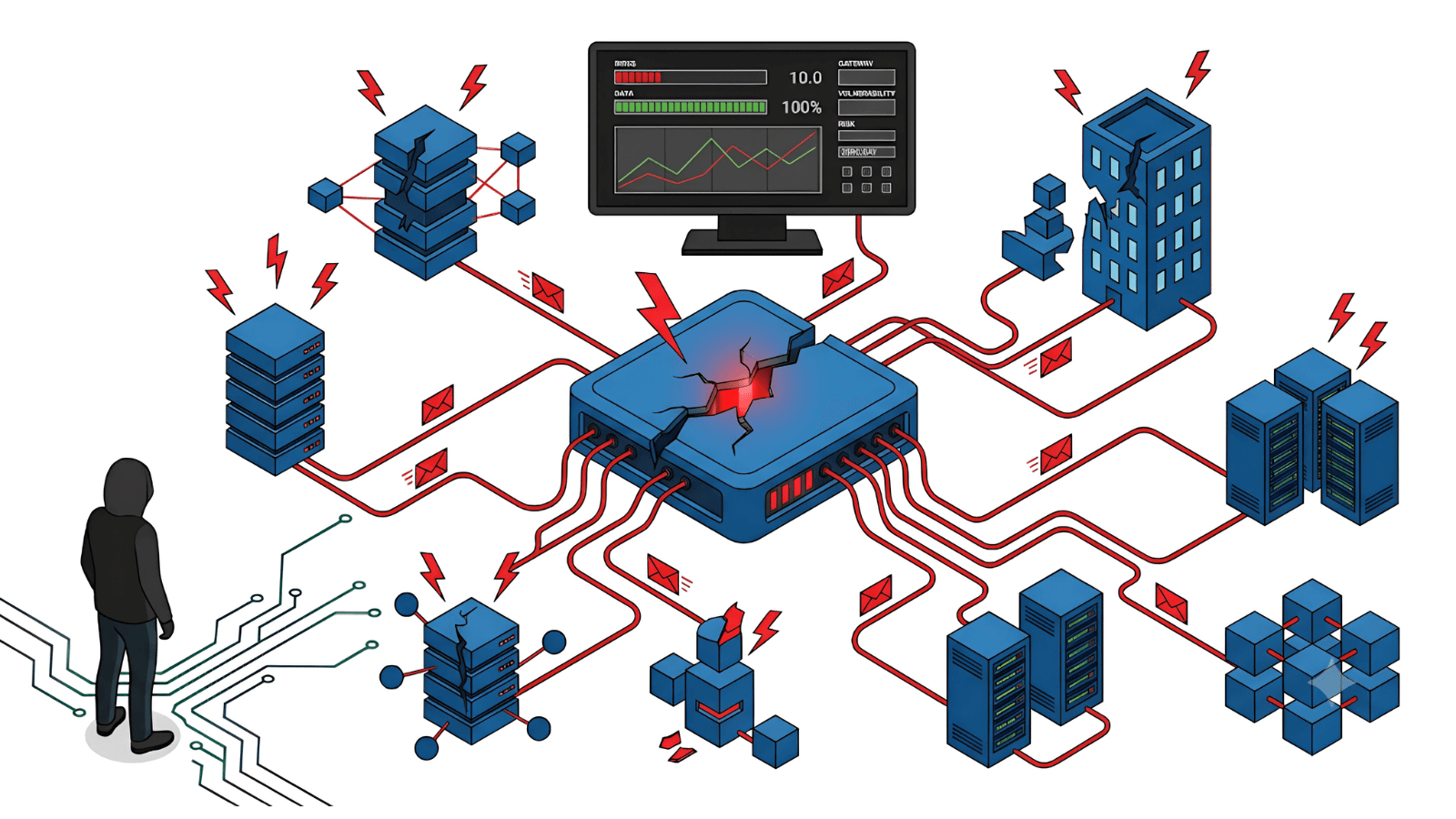
SonicWall published advisory SNWLID-2026-0008 on 14 July 2026 and released patched firmware, according to the company and reporting by Help Net Security, BleepingComputer and The Hacker News. Two flaws are involved. CVE-2026-15409 is a critical server-side request forgery bug (rated CVSS 10.0) in the appliance Work Place interface that a remote, unauthenticated attacker can use to make the appliance send requests to unintended locations. CVE-2026-15410 is a high-severity code injection flaw (CVSS 7.2) in the Appliance Management Console that lets an attacker already authenticated as an administrator run operating system commands. In the attacks seen so far, the two are used together. SonicWall said the exploitation is confirmed and, in its words, not unique to SonicWall. The US Cybersecurity and Infrastructure Security Agency added both to its Known Exploited Vulnerabilities catalogue, with a 17 July 2026 remediation deadline for federal agencies. Affected models are the SMA6210, SMA7210 and SMA8200v.
Why it matters for third-party risk
The pattern is concentration risk at the network edge. A remote-access gateway sits in front of an organisation's internal systems and is trusted to authenticate everyone who connects. When that single product can be exploited without a password, the attacker starts inside the perimeter, not outside it. The exposure multiplies through managed security service providers. A provider may operate SMA 1000 appliances on behalf of many client organisations, so one unpatched gateway can expose a whole book of downstream customers, a fourth-party effect. SonicWall's SMA line has been targeted repeatedly, through both zero-days and older unpatched flaws, so buyers should treat this as a recurring exposure, not a one-off.
What teams should take from it
Two takeaways. First, treat patching as necessary but not sufficient. SonicWall is explicit that customers should assume possible compromise: review logs for the published indicators, re-image or re-deploy affected appliances, and reset user and administrator passwords and TOTP one-time-password tokens, rather than only applying the update. Second, ask your providers, not just your own team. If a managed security or IT provider runs remote-access appliances for you, confirm in writing that they have patched, hunted for compromise, and rotated credentials, and agree how they will notify you of edge-device incidents in future.
For teams working out which suppliers sit on their critical access paths, this is a prompt to see how continuous vendor monitoring works, so an appliance flaw at a provider does not become your unseen breach.
FAQ
What should SonicWall SMA 1000 customers do right now?
Upgrade to the fixed firmware (versions 12.4.3-03453 and 12.5.0-02835), then follow SonicWall's guidance to check for indicators of compromise. If the indicators are present, SonicWall advises re-imaging or re-deploying the appliance, changing user and administrator passwords, and resetting TOTP tokens. Patching alone is not enough.
Are the vulnerabilities being exploited?
Yes. SonicWall confirmed that CVE-2026-15409 and CVE-2026-15410 are being actively exploited in the wild, used together in observed attacks. CISA added both to its Known Exploited Vulnerabilities catalogue and set a 17 July 2026 remediation deadline for US federal agencies.
We use a managed provider, not SonicWall directly. Are we affected?
Possibly. SMA 1000 appliances are used by managed security service providers to give remote access to their clients. If a provider that serves you runs one, its exposure can reach you. Ask whether they have patched, searched for compromise, and rotated credentials.
Want this applied to your supplier ecosystem? See the platform in action and map your top vendor risks live in one walkthrough.