Accenture confirmed a security incident on 8 July 2026 after a threat actor listed about 35 GB of source code and cloud access keys for sale. The company called it isolated and remediated, but did not confirm scope or client-data impact. For third-party risk teams, the exposure is the client pipelines and cloud tenants a services provider touches.
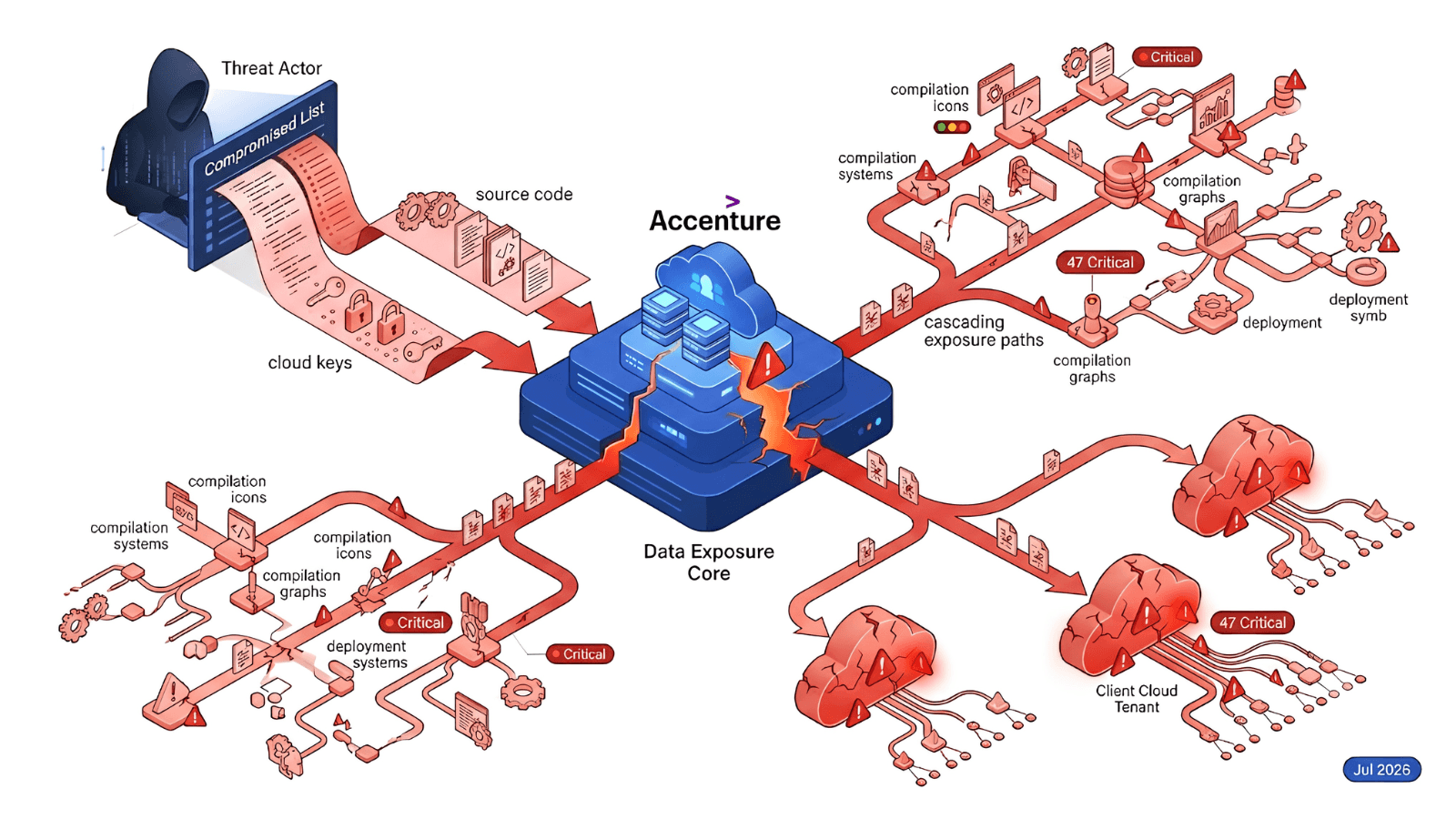
A breach at Accenture, one of the world's largest technology-services firms, shows how a supplier's stolen credentials can become a customer's problem. On 8 July 2026 Accenture confirmed a security incident after a threat actor using the handle 888 listed roughly 35 gigabytes of source code and access keys for sale on a cybercrime forum. Accenture called it an isolated matter it had remediated, with no impact to operations, and did not confirm what was taken or whether client data was involved. The lesson: a provider's build pipeline is part of your attack surface.
What happened
The listing appeared on 6 July 2026, according to reporting by BleepingComputer and Help Net Security. The actor claimed to hold Accenture source code plus credentials: RSA keys, SSH keys, Azure Personal Access Tokens (temporary keys that grant access to cloud development systems), Azure Storage Access Keys, and configuration files. On 8 July 2026 Accenture confirmed the incident, called it an isolated matter it had remediated, and reported no impact to its operations or service delivery. It did not confirm the volume or type of data taken, how access was gained, or whether customer data was affected. BleepingComputer said it could not verify the full scope, so the credential claims remain unconfirmed.
Why it matters for third-party risk
Accenture builds and runs software and cloud systems for thousands of client organisations, including banks and insurers in the European Union. That is the pattern worth naming: concentration risk. When one provider holds code and live access keys for many customers, a single breach there can reach every environment those keys still open. Source code can be rebuilt. A working cloud token or SSH key keeps opening the same door until someone revokes it. The exposure that matters is the client pipelines and cloud tenants a services firm touches for its customers.
What teams should take from it
Two moves follow. First, treat credential rotation as a supplier incident-response step, not only an internal one. If a provider manages your Azure DevOps or cloud storage, ask which keys and tokens it holds and rotate the reachable ones now, rather than waiting for a report that may never name your environment. Second, record in your vendor register which suppliers hold privileged access to your systems, not only which hold your data. A consulting firm with production access is a different risk class from a newsletter tool.
For third-party risk teams, this is the case for continuous vendor monitoring over a once-a-year questionnaire: a supplier with standing access to your systems can move from trusted to breached before your next review.
FAQ
What did Accenture confirm?
Accenture confirmed a security incident on 8 July 2026, called it isolated and remediated, and reported no impact to operations or service delivery. It did not confirm what data was taken, how access was gained, or whether client data was affected.
Why is this a third-party risk story?
Accenture manages code and cloud environments for many clients. A breach exposing a provider's source code and access keys can reach the customers whose systems those keys unlock, the defining feature of supply-chain and concentration risk.
What should downstream organisations do now?
Identify which of your credentials the provider holds, then rotate or revoke the ones still live. Prioritise cloud tokens and build-system keys, which stay useful to an attacker long after source code leaks.
Want this applied to your supplier ecosystem? See the platform in action and map your top vendor risks live in one walkthrough.